

3 Useful Secrets - June Edition
Thoughts on AI by other people (some way smarter than me) and some thoughts of my own

This month’s post may be too long to read in the email- if the newsletter is truncated, you can click on "View entire message," and you'll be able to view the entire post in your email app.
This month’s post contains a dozen or more links presented in three points, so that the format is still the same as usual, but I found that everything I read about AI sends me into a rabbit hole that also feels like a wild goose chase, all of which ends up feeling overwhelming. As with my other posts, I am not claiming this is my definitive answer, nor would I argue that this is a collection of scientifically sound arguments. I nevertheless hope that it offers you something to think about as you engage in your own exploration, whether you are totally anti-AI, or you find some of it useful for your work or personal life.
NB. I did not use any AI for writing or editing this post (I made sure that all the searches for links in the post were done without AI (I have used Google Scholar and Google search but made sure to avoid any AI generated answers).
I’ve been reading and thinking about AI a lot lately and I realised that I have a very confusing relationship with it. This morning (well, the morning I was writing this post, which is not the morning I am posting this) I came across this beautiful poem on what is lost when using AI instead of interacting with humans in your life, and it made me think that I want to share some thoughts on how I interact with AI and why I am growing increasingly uncomfortable with it - read the poem here:

As I was typing this post using Apple Pages, it kept predicting my text and I didn’t know how to switch it off (well, if I am very honest, I have not tried to figure it out — on my phone I have switched it off years ago, because I use my phone in several languages and predicting text in English doesn’t help if I text in Slovenian, French or Portuguese (which are the three languages, other than English, that I communicate in regularly). Is smart texting AI? I don’t think so- and there you go, you see, I am not sure I understand what AI is and isn’t.
Before I share the 3 Useful Secrets that will include links to articles, conversations and other resources that I have found useful, I want to be very honest about my own use of AI:
Yes, I have been using AI for some things in my life, and have found some of them very useful, some of them less so and some of them frustrating or useless. I believe I first came across ChatGPT in 2023 and found it rather scary (as in, I was not sure I wanted to register an account to open the app, as I thought it would somehow invade my laptop like some parasitical alien creature). I remember doing a big consultancy assignment on social inclusion and being told by my client that my recommendations were not simple enough for the target audience, because god forbid, they’d ask people to whom they were giving millions of dollars to make their investments more socially inclusive to do anything more demanding than box ticking on such an important issue. When I asked ChatGPT to offer some suggestions, what it came up with was so cliché that it made me cringe, but some of the suggestions appealed to my client.
A year later I asked ChatGPT for help with making a Japanese meal out of a number of Japanese ingredients that were about to perish in my pantry. I realised that if I used my Japanese cookbook, there would always be one or two ingredients that were missing and I would continue putting off using the ingredients indefinitely, because I just couldn’t be bothered to go shopping again. Instead I typed up all the ingredients I had into ChatGPT and asked it for the recipes that were limited to what I had in the pantry and fridge at the time. In the end I made these yummy and pretty looking dishes that you can see here:


Over time I have used ChatGPT:
To help me prepare for a difficult phone conversation with a manipulative person, offering possible scenarios and helping me create a list of possible answers so that I would not get triggered by this person’s deviant ways. It was super helpful in this respect.
To help me rewrite an angry draft response to someone who tried to accuse me of saying/writing something I didn’t and it actually helped deescalate the conflict. Again, super useful.
To talk me out of doing something stupid at a moment when I could not (any longer) bother my friends with the same challenge over and over again. Very useful.
To edit grammar on a messy post that I dictated to my phone in a moment of deep brain fog period, when my thoughts seemed to fly out faster than I could type and yet I felt totally inarticulate and the thought of editing grammar was overwhelming. I have (a lot of self) doubt about my grammar skills in English, especially when it comes to punctuation. I am also rather impatient and prefer to publish my writing immediately and not spend time editing it for hours on end. Again, ChatGPT was very useful.
To spellcheck and correct grammar in my Substack posts with strict instructions to not change any of the words, but occasionally allowing it to suggest shorter sentences (for reasons stated above). Very useful.
To get suggestions on alternatives to my post titles — with me often not liking what it offered, so not super useful, but not a total waste of time either.
To create images that accompany a point I wanted to make in an essay, where I didn’t have an original photo that could serve that purpose. ChatGPT, because it is large language model (LLM) is rather useless in image creation (on this note see a post by Lucy Pepper), though it did once created an image of a woman who had three hands, which I used to illustrate a LinkedIN post talking about overwhelm experienced by many of my women clients.
To re-organise content I wrote into a more coherent story, though I found that it would fabricate content that had nothing to do with my story and sneak it in. Not useful.
When using the Canva app, I have used its AI feature to redo a poster I have created using its templates, as I have to re-post an add about my workshops on LinkedIN about 10 times to get any traction because of the way algorithms. Very useful.
To rewrite the text for ads for my coaching practice, because, as with the workshop ads mentioned above, it seems I need to post these over and over again, to get some traction. I recently read that people need to see an ad 17 times before they engage with it. Rather nauseating thought, hence AI support very useful.
To write a super polite email in European Portuguese, since I can read Portuguese, but can barely write it. Very useful (though I have to always double check as it may forget and slip into Brazilian Portuguese).
To read legal contracts (in English and in Portuguese) and help me find things I need to raise with a client or a service provider (or my gym that seems to have locked my into a lifelong membership). Very useful.
To take notes during a coaching session at a client's request. I don’t find much value in it, but some of my clients find it very useful, so I don’t oppose using it, if so requested.


Since I’d rather spend my time reading (one of my favourite activities in the world) or doing bad sketches (my recent new favourite activity) while people watching and having coffee or a Select Spritz at a cafe, I have no qualms putting prompts into AI and asking it to spit out a dozen versions of the same ad. But what I always make sure I do (except for one time when I sent an email invite to an online event to my clients by pasting it directly from ChatGPT without realising that all the dates/days combinations were incorrect), is read the text it offers, delete and rewrite things that sounds cringe worthy or do not sound like me. And yet, even that is increasingly making me feel bad, though not bad enough to produce a promotional piece from scratch three times a week, which is what the recommended posting rhythm is for LinkedIN posts to get some traction.
Now that you know that I am not an AI virgin and that I have benefited from AI use in the past, and if you have not unsubscribed out of utter disgust, here are three useful secrets (or secret areas) that I want to share with you on this topic:
Secret no. 1 Ways in which AI is bad for our brains and overall health
There are a lot of arguments to say that AI makes us stupider (or is it more stupid — I could ask AI, but won’t, googling it made me realise they are both correct), and I would tend to agree with this, especially if we forget that we do have the ability (and duty) to use discernment and we fail to check on the validity of the content that LLMs produce and present as facts. I have found a number of articles and podcasts about this and have linked to some of them in the footnotes1. I will highlight some of the things I found interesting in the section that follows:
MIT research scientist Nataliya Kosmyna is quoted in this BBC article:
“She and her colleagues at MIT Media Lab recruited 54 students to write short essays and split them into three groups. One was instructed to use ChatGPT. A second could use Google search, with AI-generated summaries turned off. The third didn’t use technology. Each student’s brainwaves were measured while they worked.
The essay topics were deliberately open-ended, meaning little research was needed for the task, with prompts including questions around loyalty, happiness or our daily life choices.
The results haven’t been published in a scientific journal yet, but they were none-the-less eye-opening, according to Kosmyna. Those who used their own minds had a brain that was “on fire”, showing widespread activity across many parts of the brain, she says. The search engine-only group still showed strong activity in the visual parts of the brain, but the ChatGPT group showed notably less brain activity – it was reduced by up to 55%.
“The brain didn’t fall asleep, but there was much less activation in the areas corresponding to creativity and to processing information,” says Kosmyna.”
So, we are still using our brains when using AI, but much less than when we are not. And since we would agree that using our brains is good for us, the simple conclusion is that AI isn’t. Or is that syllogism?
An episode of podcast Science Vs.2 offers a decent summary of how AI is possibly making us use our brains less than before, while at the same time being useful to help us save time doing some dull and repetitive tasks, including when it comes to scientists having to do certain tasks that would take decades for them to complete, in a matter of days or months: they mention an hypothetical example of a physicist piecing through two hundred million images of the far reaches of the universe looking for black holes, as something that's not even humanly possible and it's certainly not possible in the span of like getting a PhD, and hence it makes sense to have the computer do it.
Here is the episode:
As I said, this post will be full of links and resources and here is another great podcast episode, looking at whether AI is eroding our critical thinking, this time from The Inquiry of the BBC.
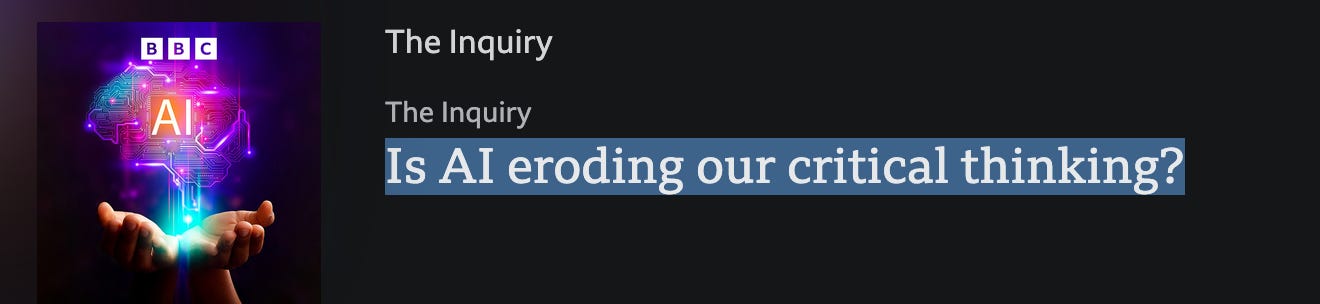
The conclusion is that AI can erode our critical thinking, if we let it…so yes, we still have the power to decide and act in a way that it doesn’t turn us into complete idiots. This episode also partly answers the question in Secret no.3 below around whether we can engage in AI use in an ethical and effective manner.
There is another aspect that makes AI dangerous and that is when people use AI to replace human interaction and are pulled into a space where the AI causes them to make poor life decisions, to the point of becoming delusional, depressed and suicidal. There are several articles I have seen on this topic, including this one in New York Times and this one in The Guardian. I have also seen a person close to me get drawn into this for a time, to the point where I was seriously worried. Luckily they found a way out and took distance from LLMs. Many people were not this lucky.
Both ChatGPT and ClaudeAI come with a disclaimer that the bot can make mistakes, but it is always written in the small print that most of ignore as we engage with online tools. Maybe it is finally time to start reading the small print.
Secret no. 2. Is AI bad for the environment?
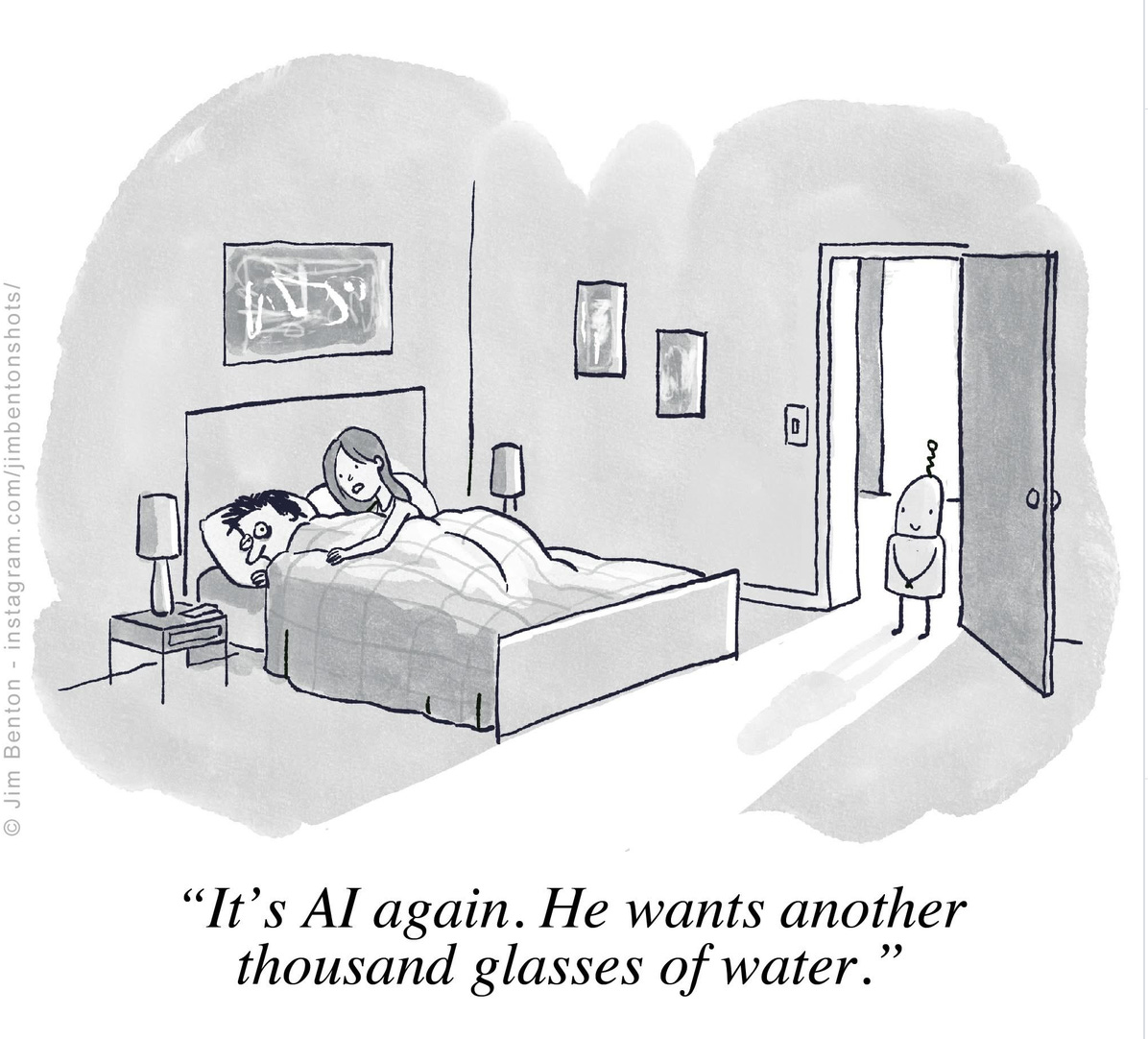
This is a point that I found most difficult find reliable resources on. It seems that there is a lot of evidence3 that suggests that generative AI and related data centers are extremely bad for the environment and that they use a huge amount of drinking water, to the point of communities worrying about their supplies.
Here is a quote from United Nations Environmental Program (UNDP) post from a couple of years ago:
[t]here are high hopes that artificial intelligence (AI) can help tackle some of the world’s biggest environmental emergencies. Among other things, the technology is already being used to map the destructive dredging of sand and chart emissions of methane, a potent greenhouse gas.
But when it comes to the environment, there is a negative side to the explosion of AI and its associated infrastructure, according to a growing body of research. The proliferating data centres that house AI servers produce electronic waste. They are large consumers of water, which is becoming scarce in many places. They rely on critical minerals and rare elements, which are often mined unsustainably. And they use massive amounts of electricity, spurring the emission of planet-warming greenhouse gases.
Greenpeace argues that:
[t]he environmental impact of AI is becoming harder to ignore, from soaring energy use and water consumption to the rapid expansion of data centres and microchip production. What is being built in the name of innovation is also concentrating power, intensifying surveillance and deepening democratic risk4.
However, some evidence I have found, suggest that those numbers are grossly exaggerated, and if not, that compared to the energy and water use of an average American household, individual use of ChatGPT is not something to lose sleep over.
I am not sure who to trust on these points, and have therefore decided to share a couple of links that I found interesting and somewhat convincing, and am inviting you to make your own decision.
Here they are:

I found this point particularly interesting from another post by Andy Masley
[i]f climate change is an emergency that requires lots of people working collectively to fix in limited time, we cannot afford to get distracted by focusing too much of our effort and thinking on extremely small levels of emissions. The climate movement has seen a lot of progress and success in shifting its focus away from individual actions like turning off lights when leaving a room to big systematic changes like building smart grid infrastructure or funding clean energy tech.
Also, this post from Hannah Ritchie

I hope you can read these articles and make up your own mind. And if you are interested in my conclusion related to the point on the environment, I have decided that I will avoid using AI for any frivolous tasks, and will only use it as a last option. No more looking up recipes or asking it to help me pack (yes, a week ago, in a moment of last minute packing stress, I asked it to coach me through a packing planning disaster). I may however ask it to help me with some more dull/repetitive tasks that I cannot avoid. I wonder if I should mention here that my carbon footprint is rather low as I walk to the grocery store, travel by public transport, don’t have A/C… or maybe you don’t care about that.
Secret no. 3. Can we engage with AI in an ethical and effective manner?
According to UNESCO, rapid changes created by AI
raise profound ethical concerns. These arise from the potential AI systems have to embed biases, contribute to climate degradation, threaten human rights and more. Such risks associated with AI have already begun to compound on top of existing inequalities, resulting in further harm to already marginalised groups.
Harvard University mentions a number of areas of concern when it comes to ethics and AI, among which it highlights AI data and privacy, possible bias in AI, AI modeling transparency and explainability. If I am mostly concerned with my personal interaction with LLMs and the unreliability of publicly available tools like ClaudeAI and ChatGPT,
internal AI systems are more powerful than publicly available LLMs and can become ever-more refined through specific prompting. As development continues — to the point where AI systems are developing themselves and other systems — reliability concerns will drop. However, more sophisticated AI systems raise other concerns, like the possibility of superintelligence and what that could mean for the workforce and society5.
This need to regulate AI use and understand its ethical concerns is increasingly important. Dr Sam Illingworth who writes about AI on Substack wrote this post highlighting the role we all play in ensuring AI is more ethical.

Given my background in African studies, gender equality and social inclusion research and implementation, I am particularly concerned with the racial and gender bias I have encountered when using LLMs and hope to pay more attention to this in the future.
Another thing that I’d like to mention here is that I would welcome some regulation/requirement around a use of a disclaimer when we used AI to generate any content, as there are many opportunities to be mislead by AI content that is less easy to identify.
When it comes to writing on Substack, my recommendation would be to mention if your publication makes use of LLMs to generate or edit texts (beyond a basic spell check) or to create images and let your readers decide if they find that offensive. As reader, if I can tell that you’ve done research to create the content, but are relying on AI to help you edit text and I can still sense your personality in the text, then I am less upset about it than when I have a feeling you’ve just dropped a prompt into Claude and asked it to generate a post which you’ve then copy pasted and sold as you own. I guess the reason I feel this way is that in the early days of using AI, I have possibly been negligent enough to accept and publish certain AI edits of my texts, which I later found problematic. I hope my readers will challenge me if they think anything I’ve done is unethical, while I promise —from now on — to be even more careful and further limit any AI use and try and make it aligned with my values around honesty, transparency, professionalism and work ethic. And I guess you will finally realise how bad my punctuation is…
So, this is it for the 3 Useful Secrets in June, where I have explored the challenges with using AI and LLMs.
While I don’t wish to suggest that I have exhausted my thinking on the topic, I would say in conclusion to this post that while there are definitely some aspects of AI that can be helpful, using it without discernment is where the biggest danger lies. And to use discernment, we need to have a good baselines understanding of any topic, we need to be able to question information, we need to have the ability to triangulate the data we are presented with. Basically, need to be using our brains to think and not outsource thinking to a machine.
In addition to the links already shared in each of the three Secrets, I’m adding links here to a number of recent Substack posts about AI that made me think, and even re-think my past AI use.
Lucy Pepper has written an insightful series of posts about generative AI in general and how it related to the field of illustration. You can find the first post here and then find your way to the next ones.
Allison Wright wrote a very long post about how to develop your own writing style, one that is not AI generated here. [I should admit that I listen to it using the AI voice over that Substack offers.]
Betina Cunado writes about AI ethics here.
Karen Spinner wrote this post with the results of an analysis of 16,000 Substack posts to find AI writing on the platform.
Arielle Swedback reports on Substack’s own survey of 2000 writers’ use of AI on the platform.
Joan Haig wrote this piece to honour writing in the time of AI.
Also, if you are looking to ‘unmachine’ yourself, here is a post for you by Ruth Gaskovski and Peco.
How do you engage with AI? Are you able to discern AI posts and do you, like me, occasionally refuse to click a like on a useful post, just because it was clearly thoroughly edited (if not completely written) by AI? Are you someone who has never, to their knowledge, used AI? Are you someone who doesn’t care? I would be curious to hear from you in the comments.
More podcasts and an article discussing how AI is possibly making us dumber: https://www.theguardian.com/science/audio/2025/dec/02/is-ai-making-us-stupid-podcast; https://thecuriosityshop.com/podcast/ai-commencement-speeches-and-why-human-thinking-still-matters/ (this is from the brilliant Brené Brown and Adam Grant) ; https://www.psychologytoday.com/us/blog/the-neuroscience-of-personal-growth/202504/will-ai-make-you-dumber-its-up-to-you-heres-how-0
Here is the full transcript of the podcast: https://docs.google.com/document/d/e/2PACX-1vSJ1QsCzpCXnqdpRm6vcaJpO3emyDSgKc-bygHb_LQ9QJ2M7gNVaUQ-1wA6MhMUVg45rDuEaMSIvL12/pub
Here are some articles from news websites and from research on this (some may be paywalled and I don’t have a gift article to share: https://www.theguardian.com/australia-news/2026/mar/13/ai-datacentres-environmental-impacts; https://unu.edu/inweh/collection/environmental-cost-of-AIs-Enrgy-Use-Carbon-water-and-land-footprints; https://www.theverge.com/tech/948534/amazon-data-centers-water-use; https://www.aquatechtrade.com/water-stories/digital-solutions/ai-water-usage; https://unric.org/en/artificial-intelligence-how-much-energy-does-ai-use/
Lots of good insight as usual, Liza. Thank you.
Interesting, honest, and balanced. I enjoyed reading this, Liza, even though I remain firmly AI-averse. I do recognise its value for certain things but I think it’s a slippery slope!